

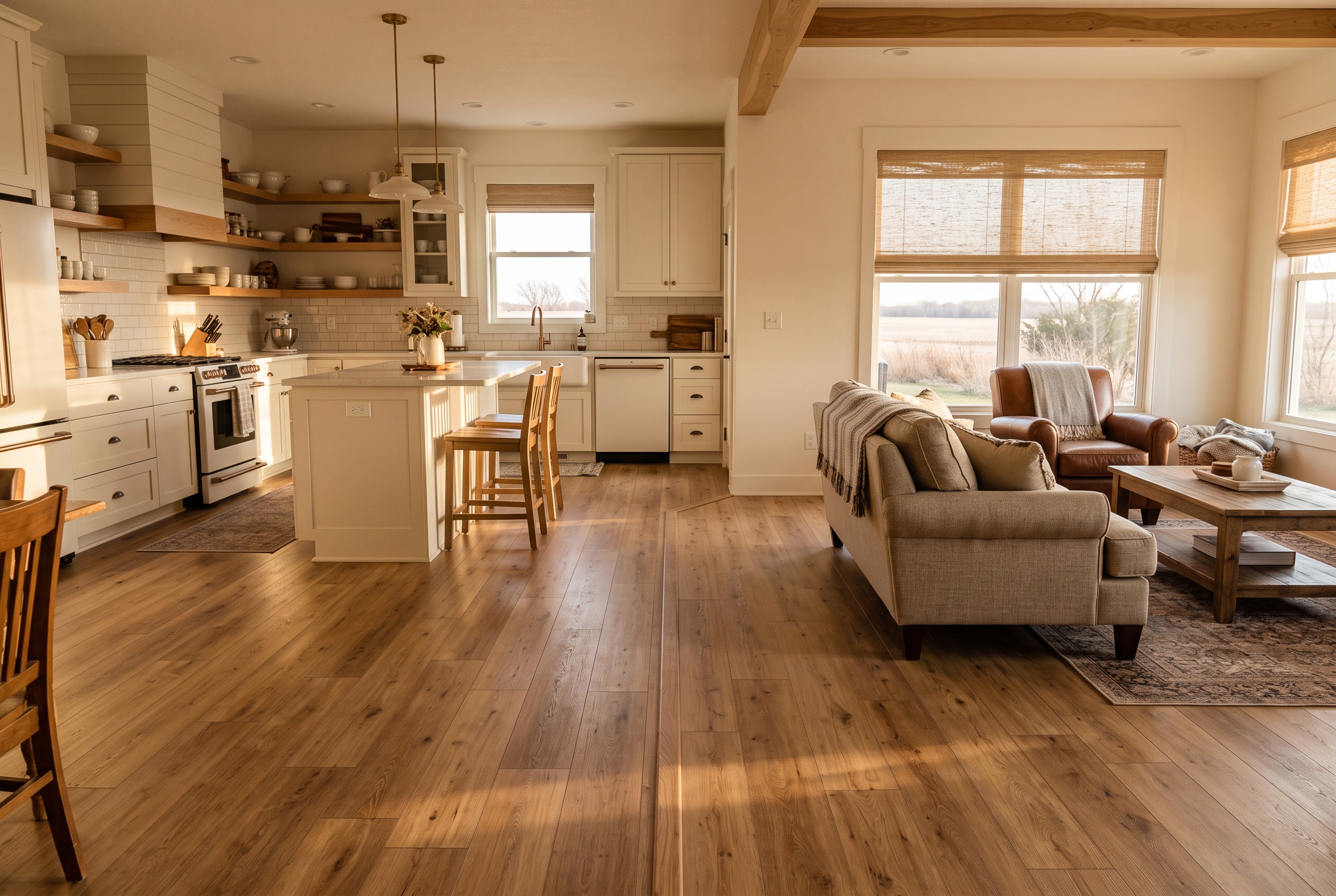
Luxury vinyl and laminate both put a wood or stone look on a floating floor. Three things decide between them: how much water the room sees, what the floor has to stand up to, and how you want it to feel and sound. Neither one wins every room, which is why plenty of homes end up with both.
Kitchens, full baths, laundry rooms and mudrooms lean toward luxury vinyl, because its planks are waterproof all the way through. A waterproof laminate handles everyday kitchen spills well, but a bathroom with a tub or shower is vinyl's room.
Busy living spaces with dogs can go either way. Laminate's hard surface is built to resist scratches, while luxury vinyl is quieter under paws, more forgiving of accidents and better at shrugging off dents. Choose by which you would mind more.
Basements on a concrete slab lean toward luxury vinyl. Laminate can go below grade only where its maker allows it and the slab stays dry.
Rooms where the look comes first often favor laminate, whose thick top layer carries deep wood-grain texture on long, wide planks. The best vinyl lines come close, so compare samples in your own light.
Rooms with strong sun need window coverings with either floor, and floating vinyl needs them most, since heat and direct sun can make it expand.
Budgets can be met with either floor, because the specs inside each, such as the wear layer, the core, the abrasion rating and the water rating, move the price more than the category does.
| If this matters most | Lean toward | Why |
|---|---|---|
| Water, spills, a tub or shower | Luxury vinyl | Waterproof plank, core included |
| Claws and grit | Laminate | Very hard, scratch-resistant top |
| Dents, comfort, quiet | Luxury vinyl | Softer, quieter, dent resistant |
| Wood-look realism | Laminate, or premium vinyl | Deep texture, long planks |
| Basement slab | Luxury vinyl | Suits a below-grade room |
| Hot, sunny room | Either, with shades | Vinyl moves most in heat |
| Tight budget | Either | Compare specs, not category |
How Luxury Vinyl and Laminate Are Built
Luxury vinyl plank (LVP) is a plastic plank and laminate is a wood-fiber plank, and that difference in the core explains most of what follows. Both carry a printed image of wood or stone under a clear, tough top layer, and both usually click together and float over the subfloor without glue or nails.
Luxury vinyl's core is either rigid or flexible. A rigid core is SPC, a dense stone-plastic blend of ground limestone and vinyl, or WPC, a foamed vinyl core that is a little softer and lighter. Flexible vinyl is thinner and usually glued down.
On top of the core sit the printed film and a clear wear layer measured in mils. Our luxury vinyl guide shows the layers. This is a different product from the old sheet vinyl that came on a roll.
Laminate's core is high-density fiberboard, or HDF: wood fibers pressed hard with resin. Over it go a photographic layer and a hard, clear top coat, and many laminates have a pad attached underneath. Our laminate flooring guide covers how it is made and where it works.
How Each Floor Handles Water
Luxury vinyl planks are waterproof through and through, and many laminates are now waterproof against surface water for a rated number of hours. So the real question is how much water a room sees, and for how long.
Neither floor, once installed, is a sealed tub. Water that gets under any floating floor, from a leaking dishwasher line or a flood, has to come up and be dried, along with the subfloor beneath it.
Is Laminate Waterproof?
It depends on the laminate: standard laminate is not, but much of today's laminate is, within limits. Its wood-fiber core swells if water sits long enough to work into the seams, so makers seal the surface and the joints and rate them for how long surface water can sit without doing harm.
All three laminate makers in our catalog sell theirs as waterproof against everyday spills. Bruce rates its TimberTru laminate against water sitting on top for up to 24 hours. Portercraft's EverPlank XL passes the laminate industry's 24-hour surface water test, which checks that water standing on the floor for a day does not seep through the seams or warp the planks.
That is protection for the spill you find and wipe up. It does not cover standing water from a flood or a leak underneath. The North American Laminate Flooring Association advises keeping laminate out of very wet rooms, such as bathrooms, unless its maker specifies it as waterproof for that use. Read the box for the rating and the rooms it names.
Is Luxury Vinyl Waterproof?
Yes, luxury vinyl planks are waterproof, core and all, so a spill, a wet dog or a dripping boot will not hurt them. The installed floor is still not a membrane. Water can run through the edges and seams to the subfloor, and a subfloor that stays wet can grow mold under any floor.
That is why vinyl in a bathroom is sealed along the tub and toilet with silicone caulk, as its maker specifies, and why a big leak means lifting the planks to dry what is underneath. Some premium vinyl lines in our catalog also have locking joints designed to keep fluids from seeping through.
Mopping Luxury Vinyl and Laminate
Clean luxury vinyl with a damp mop and a pH-neutral floor cleaner. Skip anything labeled wax, polish, shine or citrus, and keep vacuums with spinning beater bars off the floor. Some vinyl lines are approved for a steam mop, so check yours before you use one.
Laminate does best with as little water as possible. Blot spills with a damp cloth as soon as they happen, clean with a damp mop rather than a wet one, and never let liquid stand. Steam mops are out, because steam can damage and warp laminate.
Scratches, Dents and Dogs
Laminate is the more scratch-resistant floor, and luxury vinyl is the more dent-resistant and comfortable one; that is how Shaw Floors, which makes both, describes them. Which matters more for your floor depends on what it faces: claws and grit, or heavy furniture and dropped things.
Scratches come mostly from grit ground in by shoes, from claws and from chair legs and appliances dragged across the floor. Laminate's hard top coat is built to resist those fine scratches. Vinyl's clear wear layer handles scuffs and daily traffic, and premium lines are narrowing the gap with scratch coats made with aluminum oxide, the same hard mineral used on many laminates.
Dents come from weight on a small spot, such as a refrigerator wheel, a piano leg or a dropped cast-iron pan. Vinyl gives slightly and recovers, and a rigid SPC or WPC core resists denting better than thin flexible vinyl. Laminate does not dent easily, but a hard knock at a plank edge can chip it.
With dogs, laminate shrugs off claws, while vinyl is quieter under clicking nails and takes an accident in stride. On laminate, an accident needs wiping up within the floor's water rating. Older dogs can slide on any smooth hard floor, so a textured finish and a few runners in their paths help them keep their footing.
With either floor, keep nails trimmed, put mats at the doors where grit comes in, use felt pads under table and chair legs, and put wide casters or protectors under heavy furniture. Our post on protecting floors from pets and grit goes further.
Which Looks More Like Real Wood?
Laminate usually has the edge on looking like real wood, because its thick top layer can carry deep texture that follows the printed grain and it often comes in long, wide planks. EverPlank XL, one of the laminates we carry, comes in planks almost 10 inches wide and more than 6 feet long.
The best luxury vinyl comes close, with the same grain-matched texture, convincing bevels and planks up to about 6 feet long in premium lines. What gives either floor away is usually repetition. Every plank is a photograph, and a line with only a few different prints repeats them across the room. Better lines carry many more; EverPlank XL, for example, runs up to 150 different plank images before one repeats. On a sample board, look for the same knot twice.
A matte, textured finish also hides dust, paw prints and fine scratches better than a glossy one on either floor. The honest test is in your house: look at samples on your floor, in your light, next to your trim and cabinets. You can order samples from our catalog, or our shop-at-home service will bring them to your door.
How Each Feels and Sounds Underfoot
Luxury vinyl feels softer and a little warmer and is quieter to walk on, while laminate feels firmer and more like wood and depends on its underlayment to avoid sounding hollow. Both feel cooler over a concrete slab than over a wood subfloor.
Within vinyl, a WPC core is softer underfoot than SPC, which you notice in a kitchen where you stand for an hour at a time. Laminate relies on the layer beneath it for sound and warmth, so a quality pad is part of choosing laminate, and some come with cork already attached. Underlayment under vinyl plank follows its own rules, set by each plank's maker.
Sound matters most in a bedroom or playroom over a living room. Footsteps on any hard floor carry to the room underneath, so choose a plank with a good attached pad and add area rugs where you walk most. Over a basement slab in January, a rug also takes the chill off.
Sun, Heat and Kansas Temperature Swings
Both floors float, so both expand and shrink with the seasons and need a small gap at every wall. Luxury vinyl reacts more to heat and direct sun, while laminate reacts more to humidity, so different rooms test each.
For vinyl, the maker's limits are worth knowing. Mannington installs its ADURA Max vinyl in rooms held between 55 and 90 F, says the room should never fall under 55 F, and says the floor should never be exposed to more than 140 F. Long hours of direct sun through a south or west window can heat a floating vinyl floor enough to expand and buckle it.
So close blinds or shades at peak sun, and in a sunroom that bakes all afternoon, consider a glue-down vinyl instead of a floating one. Radiant floor heat is fine under floating vinyl within limits; the same maker caps the floor surface at 85 F over hot-water radiant systems and 80 F over electric mats the heating maker approves.
Laminate's wood-fiber core takes on and gives off moisture with the air, so it wants a house that stays climate-controlled all year. In our hot, humid summers and dry, heated winters, that means running the air conditioning in July and the heat in January. A cabin or three-season porch left unheated all winter is a poor fit for either floating floor.
Window treatments do double duty here. Our window coverings manage the light that fades and heats a floor, which protects either one.
Basements, Slabs and Uneven Farmhouse Floors
Basements on a slab lean toward luxury vinyl, because a basement is where water is likeliest to show up. Laminate can work there only where its maker allows it and the slab stays dry, and never in a room with a floor drain. Our post on when laminate works in a basement covers that decision in detail.
Both floors need a flat base. A common maker limit is no more than 3/16 inch of dip or hump over 10 feet, a little less than the thickness of three stacked quarters across a long room. Rigid-core vinyl bridges small texture in the subfloor slightly better, but neither floor hides a real dip. Old farmhouse plank floors and patched subfloors usually need flattening first, which our guide to subfloor problems under laminate explains.
Over existing tile, some vinyl lines go straight over the grout lines and others want them filled first, so the plank's instructions decide.
Luxury Vinyl vs. Laminate Cost
Luxury vinyl and laminate overlap in cost, and the specs inside each move the price more than the category does. These are the parts that set it:
- For vinyl: the core (SPC or WPC), the wear layer thickness, an attached pad, plank size and texture.
- For laminate: the abrasion rating, the water rating, thickness, plank size and an attached pad.
- For either: stairs, subfloor flattening, removing the old floor and the transitions at doorways.
Installation costs are similar, because both click together and float. Vinyl is a little easier to cut, since it can be scored with a utility knife, while laminate needs a saw. Stairs are slow handwork with either.
The quickest way to compare real prices is to choose a vinyl and a laminate you like and have us quote both for your rooms. If the project is bigger than the budget this year, financing through our lending partners can spread out the cost.
Which Lasts Longer?
Neither floor lasts longer by category; the spec, the room and the care decide it. A laminate with a high abrasion rating and a vinyl with a thick wear layer will both last many years in a busy home, while a lighter-duty version of either shows wear sooner.
Standing water is what shortens a laminate's life, and grit and heavy point loads are what shorten a vinyl's. Both typically come with long residential warranties against wear, and the water coverage is the part that differs most from line to line.
The paperwork that comes with your floor is what counts, and we go through it with you before you order. Our post on understanding flooring warranties explains what these warranties usually cover.
Room by Room in a Kansas Home
Room by room, the choice between luxury vinyl and laminate usually sorts itself by water first and wear second.
| Room | Lean toward | Watch for |
|---|---|---|
| Mudroom and back entry | Luxury vinyl | Grit; mats at the door |
| Kitchen | Vinyl, or waterproof laminate | Dishwasher and sink leaks |
| Full bath | Luxury vinyl | Caulk at tub and toilet |
| Half bath and laundry | Luxury vinyl | Washer hose leaks |
| Basement | Luxury vinyl | A dry slab first |
| Living and family room | Either | Dogs, sun, sound |
| Bedrooms | Either | Sound for rooms underneath |
| Sunroom | Either, with shades | Heat and fading |
| Stairs | Either | Matching stair nose pieces |
| Home office | Either | A chair mat under casters |
A mudroom or back entry on a farm sees mud, gravel and wet boots every day, so vinyl's waterproof core earns its place there, with a heavy mat at the door to catch the grit. In a kitchen, vinyl's comfort for long hours of standing and its tolerance of a leaking dishwasher make it the safer pick. A waterproof laminate with a 24-hour rating is a fair choice if you wipe up spills promptly.
Full baths and laundry rooms belong to vinyl, sealed at the tub and toilet and with the washer hoses checked now and then. Basements lean to vinyl over a dry slab. Living rooms and bedrooms are where the choice is genuinely open, and looks, sound and dogs usually decide it.
A sunroom can take either with good shades, and floating vinyl needs them most. On stairs, either floor is finished with matching stair nose pieces from the same maker. In a home office, put a chair mat under a rolling chair whichever floor you pick. Browse both in our luxury vinyl catalog and our laminate catalog.
Reading the Two Labels Side by Side
Luxury vinyl and laminate labels use different numbers for toughness, so the two boxes cannot be compared line for line, and each floor's numbers have to be read on their own terms.
On luxury vinyl, the wear layer is the clear top layer, measured in mils, or thousandths of an inch. Thicker is tougher, and the vinyl in our catalog runs from 6 to 30 mil. The core type, SPC or WPC, and whether a pad is attached are the other lines to read. Our post on vinyl wear layers and cores decodes them further.
On laminate, the AC rating is the number most boxes print. It comes from a European wear test and runs from AC1 to AC6, and a higher number means the surface stands up to more abrasion. The North American laminate standard does not use AC numbers. It certifies laminate for residential or commercial use instead, so the North American association's seal is the other mark to look for. Laminate also lists its thickness in millimeters and, if it is waterproof, how many hours of surface water it is rated for.
Using Both in One House
Using both floors in one house works well when the meeting points are planned. The usual split is vinyl in the kitchen, baths, laundry and mudroom, and laminate in the living areas and bedrooms where looks and scratch resistance lead.
Plan the transitions first. The two floors are rarely the same thickness, so where they meet, a reducer or a T-molding strip bridges them, and a doorway is the natural place for it. Very large open areas need a break too, since floating vinyl lines limit how far one unbroken run can go; some cap it at about 50 feet.
Then the direction and the color. Run both floors the same way where they can be seen together, and choose the two so they look intentional side by side, either a close match or a clear contrast. That is the kind of decision our design consultations are for.
When Either Floor Goes Wrong
When either floor goes wrong, the cause is usually water, heat or installation, and both can be repaired plank by plank.
Laminate planks swollen and raised at the edges have had water sit on them or get under them. The swollen planks need replacing, the subfloor has to dry, and the source, often a dishwasher, ice-maker line or sink, has to be fixed first.
Luxury vinyl that has gapped, peaked at the seams or buckled has usually moved with heat it could not escape. Common causes are strong direct sun, a missing expansion gap at a wall, and a floor pinned in place by cabinets, an island or nailed trim; floating floors must never be fastened down. Relieving the pinch point and shading the sun fixes the cause, and the damaged planks get replaced.
Dents come from heavy point loads, and protectors prevent them. A deep scratch or chip in either floor is fixed by replacing that plank, which is why we suggest keeping a few spare planks from your order on a shelf in the garage.
Seeing Both Floors With Us
At Draperie Decor Interiors in Sabetha, we carry and install both floors, so you can see them side by side. Our luxury vinyl comes from Mannington's ADURA APEX, Flex and Max lines, COREtec, Shaw Floors, MSI and other makers. You can filter it online by SPC or WPC core, wear layer, built-in underlayment, and floating or glue-down installation.
Our laminate comes from Bruce (TimberTru), Portercraft Floors (EverPlank XL) and Shaw Floors (Oak Crest and Oak Grove).
As a design studio, we usually start with your rooms and how you live in them before we get to spec sheets. Installing the floor you choose is part of our flooring services, and our customers come from all over northeast Kansas and southeast Nebraska, including Sabetha, Hiawatha, Seneca, Marysville and Falls City.
Questions About Vinyl and Laminate
Do High-End Homes Use Laminate?
Yes. Well-made laminate and luxury vinyl both turn up in fine homes, because buyers judge a floor by how it looks and how it has held up. If you want the real thing, our hardwood flooring guide covers that choice.
Which Is Healthier, Vinyl or Laminate?
It depends on the product's emissions certification more than on whether it is vinyl or laminate. Look for FloorScore or Greenguard on whichever floor you choose; both mean the product was tested for low chemical emissions.
Can You Put Luxury Vinyl Over Laminate?
No. Luxury vinyl goes over one hard, flat, fully attached layer, and laminate is itself a floating floor, so the old laminate comes up first.
Is Luxury Vinyl or Laminate Better for a Rental?
It depends on what the rental puts the floor through: luxury vinyl usually suits it better, because tenants, pets and spills test water resistance more than anything else, and a damaged plank is easy to replace. A waterproof laminate is a fair choice for rental living areas and bedrooms where scratches are the bigger worry.
If you are weighing the two for your own rooms, bring us the rooms and the life they see, and we will help you sort out where each one belongs. You can request a consultation to get started.


