

In a farmhouse, the mudroom is a light-commercial floor pretending to be a residential one, which is why the rating on the laminate box matters more there than almost anywhere else in the house. Boots, grit, snowmelt, the dog, groceries dropped on the way to the counter: the surfaces by the back door, through the kitchen and down the hall take more abuse in a week than a formal living room sees in a year. Laminate is one of the best answers for those rooms, but only when it's chosen by specification rather than by the photo on the display. Get the spec right and the floor shrugs off farm life for years. Get it wrong and it wears through in the traffic path.
Here is how to read the specs that actually predict how laminate survives a working rural home, and what to demand of it room by room around Sabetha and the northeast Kansas towns we serve.
What Makes Laminate Hold Up to Farm Life?
Laminate holds up because of how it is built and how it is tested, and both are worth understanding before you shop. A laminate plank is a dense wood-based core topped by a printed image of wood and a clear wear layer, and that wear layer is what stands between farm grit and the picture underneath. The way to know a plank was built to perform is third-party testing. Laminate that carries the North American Laminate Flooring Association's certification has passed its ANSI-accredited LF-01 standard, which puts a floor through 14 separate categories, among them wear, impact, moisture resistance, dimensional stability and how it survives a rolling chair.
The LF-01 categories map almost one to one onto farm-house problems. Impact resistance is the dropped cast-iron pan. Dimensional stability is the plank staying put through a Kansas temperature swing. Moisture resistance is the snowmelt off a pair of chore boots. When a floor is certified, those are not guesses about how it will behave; they are properties someone measured. That's the difference between a floor chosen for its looks and a floor chosen to last, and in a working home the second one is the only one worth buying.
What the AC Rating on the Box Actually Means
The AC rating is the single most useful number on a laminate box, because it grades exactly the thing farm life attacks: surface wear. AC stands for abrasion class, a scale that runs from AC1 to AC5, and up to AC6, set by the European standard EN 13329 and produced by a Taber test that spins abrasive wheels against the surface until the printed layer wears through. The more rotations a floor survives, the higher its class. AC3 is rated for the traffic of an ordinary home, while AC4 and AC5 are built for light-commercial and commercial use.
For a farmhouse, that scale argues for aiming higher than the household minimum in the rooms that take a beating. AC3 is genuinely fine for bedrooms and a quiet living room, but a mudroom, an entry and a main hallway in boots-and-dog country are closer to light-commercial traffic than to a spare bedroom, so an AC4 rating buys real margin there for a small step up in price. Think of the number as matching the floor to the traffic: set it by how hard the room is used, and the busiest rooms in a working home earn the higher class.
How Water-Resistant Is "Water-Resistant" Laminate?
Water-resistant laminate buys you time against spills and tracked-in snow, but it is a different promise from waterproof, and the gap matters most in exactly these rooms. Water resistance is something the industry actually tests: NALFA runs a Surface Swell Test that measures whether an assembled floor's locked joints can take prolonged water exposure. A water-resistant floor is built to let you wipe up a puddle by the mudroom bench or a dripped coat before anything reaches the core. It's not built to sit under standing water for a day, and the fine print almost always sets a time limit.
Knowing that line tells you where laminate belongs and where it does not. Through most of a farmhouse, mudroom included, a quality water-resistant laminate handles the reality of the room. In the genuinely wet spots, a floor drain in a back entry, the splash zone at a utility sink, a spot that has flooded once already, the honest move is waterproof luxury vinyl instead, coordinated in tone so the transition reads as intentional. We laid out where that line falls below grade in our guide to designing dry basements, and the same judgment applies to a wet corner of a mudroom.
The Mudroom: Your Whole House's Dirt Filter
The mudroom earns the highest spec in the house because it's the filter that catches everything before it reaches the rest of your floors. It is where boots come off, where the dog shakes, where a bag of feed gets set down, and the grit that lands here is the single fastest way to age any floor, because fine sand grinds a wear layer like sandpaper underfoot. So this room wants the most abrasion resistance you're willing to buy, an AC4 rating rather than AC3, on a water-resistant plank, in a texture that fights wear on two fronts.
Texture and layout do the rest of the work. A low-sheen, wire-brushed or hand-scraped surface hides the dust and paw prints that a glossy plank would flaunt, and a medium wood tone, neither pale nor near-black, disguises everyday debris between sweeps. Pair the floor with a washable walk-off mat at the door so grit gets trapped before it travels, the same first line of defense we cover in our guide to protecting floors from pets and grit. A mudroom floor specified this way does its hard job quietly and still looks like part of the house.
Kitchens and Hallways: Where Style Meets Daily Mess
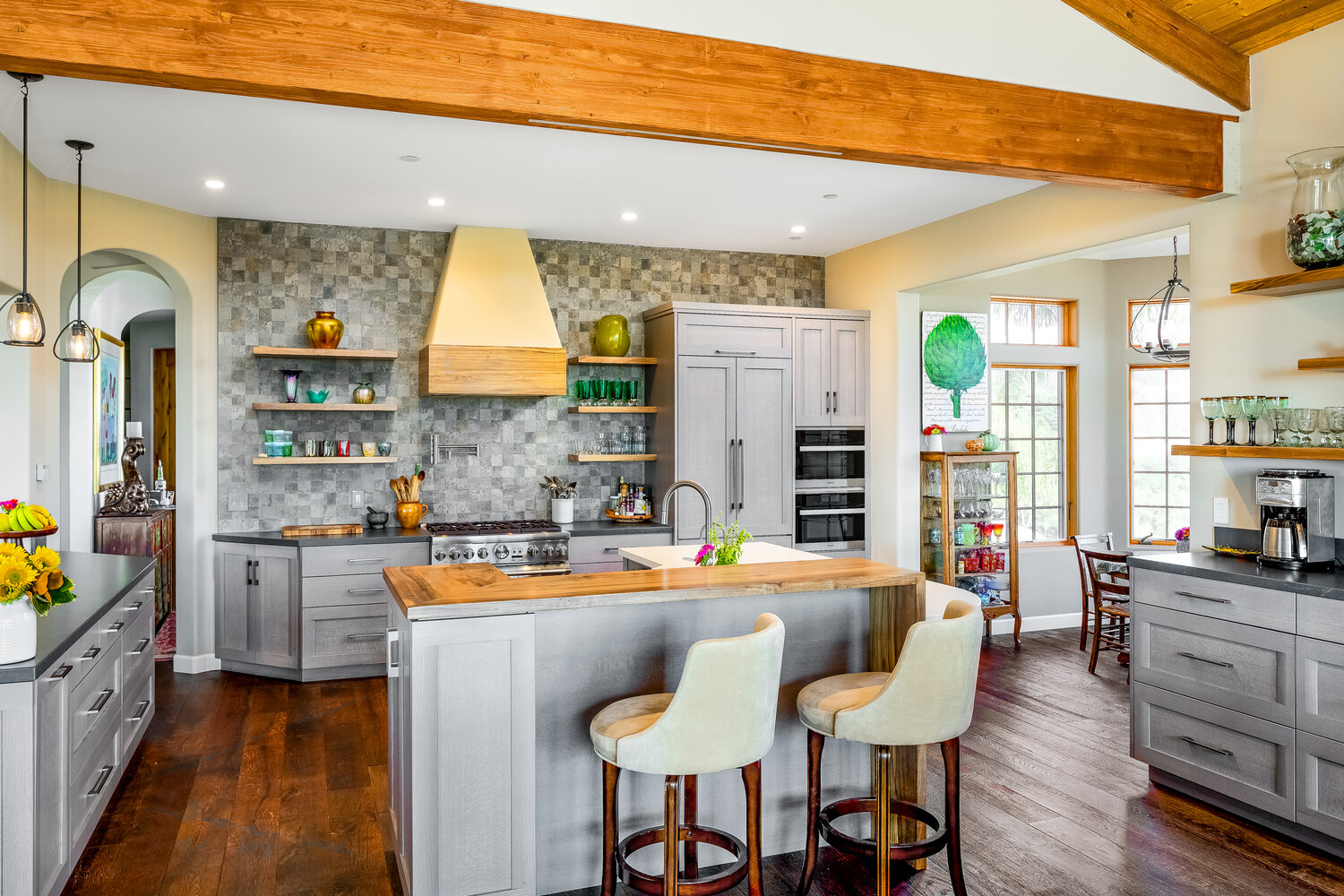
Kitchens and hallways are where the farmhouse floor has to be tough and good-looking at once, because they are both the hardest-working and the most-seen rooms on the main level. The kitchen is the hub from the first cup of coffee to canning season, and the hallway ties the whole floor together, so both see constant traffic and the occasional spill. A water-resistant laminate at an AC3 rating or better handles a kitchen well; if the kitchen opens onto a busy back entry, treat it like the mudroom and step up to AC4.
The design payoff comes from continuity. Running the same plank from the kitchen through the hall and into the adjoining rooms makes the main level read as one considered space instead of a patchwork, and a wider plank with a beveled edge adds farmhouse character while the bevel quietly disguises minor wear at the seams. This is also where the climate earns a mention: laminate is happiest in a home kept near 60 to 80 degrees and 30 to 50 percent relative humidity, because its wood-based core moves when the indoor air swings far outside that band, so leaving the correct expansion gap at the walls is what keeps a long continuous run flat through the seasons.
Choosing Color and Texture That Hide Farm Grit
The right color and texture make a hardworking floor look clean between the sweeps it will not always get on schedule. Northeast Kansas hands a floor real extremes to live through, from July highs near 89 degrees to January lows around 20 degrees on about 36 inches of precipitation a year, and that means dust in the dry stretches and mud in the wet ones. A medium wood tone in a matte, textured finish is the most forgiving choice, because it breaks up the light and hides both the pale dust of a dry August and the darker grit of a March thaw.
Avoid the two extremes for a working floor. A very dark, high-gloss plank looks striking in a showroom and shows every speck and paw print in a real mudroom, while a very pale floor reads clean but telegraphs mud and pet hair. The wire-brushed and hand-scraped textures that are already in style happen to be the practical pick here too, because their surface variation is doing camouflage work every day. Style and stamina are pointing at the same plank.
Matching the Floor to the Room
| Room | What it takes | Minimum AC rating | Features to look for |
|---|---|---|---|
| Mudroom / back entry | Grit, snowmelt, boots, the dog | AC4 | Water-resistant, low-sheen, textured, medium tone |
| Kitchen | Spills, standing, heavy traffic | AC3-AC4 | Water-resistant, beveled edge, matte finish |
| Hallways | Constant through-traffic | AC3-AC4 | Continuous runs, wear-hiding texture |
| Bedrooms / quiet living | Light foot traffic | AC3 | Comfort and looks lead; wear is secondary |
| Wettest spots (utility sink, floor drain) | Standing water risk | Consider waterproof LVP | Coordinate tone with adjoining laminate |
Questions We Get About Laminate for Farmhouses
What AC rating do I need for a farmhouse mudroom?
Aim for AC4 in a mudroom or back entry. Those rooms carry closer to light-commercial traffic than the rest of a house, given the grit and boot traffic, and AC4 gives real wear margin for a small price step over the AC3 that suits calmer rooms. AC5 exists for genuinely commercial settings and is more than a home needs, so AC4 is the practical target for the hardest-used rooms in a working house.
Is water-resistant laminate good enough for a farmhouse kitchen?
For most farmhouse kitchens, yes. A quality water-resistant laminate is built to handle the spills and mopping a kitchen sees, as long as standing water gets wiped up rather than left to sit. The exception is a spot with a real flooding risk, like a utility area or a back entry with a floor drain, where waterproof luxury vinyl is the safer specification and can be matched in tone to the laminate beside it.
Will laminate gap or buckle with Kansas temperature swings?
Not if it's rated for stability and installed with the right expansion gap. A laminate plank has a wood-based core that moves slightly as indoor humidity rises and falls across the seasons, which is why the installation leaves a gap at the walls for the floor to breathe and why NALFA tests dimensional stability in the first place. The base has to be flat too: installers hold the subfloor to within about 3/16 inch over 10 feet so a floating floor doesn't flex and separate at the joints. A certified floor installed correctly in a home kept in a normal comfort range handles the swings without gapping or buckling.
Planning Farmhouse Floors That Can Take It
The floors that survive farm life are matched to each room's real workload, and that match is easier to get right with someone who can read the specs with you. You can start in our laminate guide, compare the range in the laminate we carry, and see how our installation services handle the prep and expansion gaps that keep a long run flat. When you are ready, request a consultation and we will walk your mudroom, kitchen and hallways, talk through AC ratings and water resistance, and map the right laminate to the way your home actually lives.


