

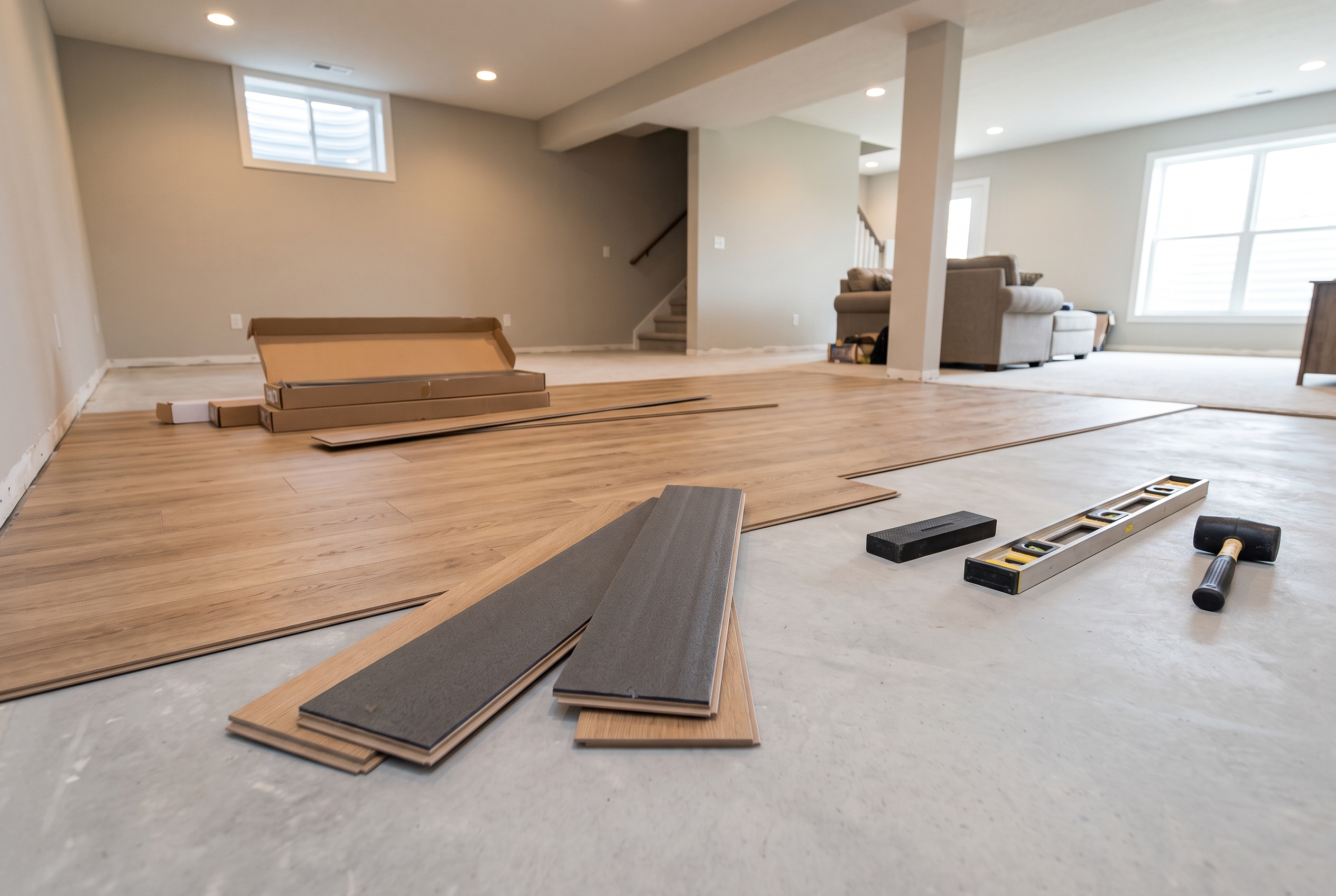
Whether you need underlayment for luxury vinyl plank depends on what is already on the back of the plank and what is under the floor. Most planks sold today have a pad attached, and those need nothing more unless their maker names an approved add-on. Planks without a pad need one layer of the underlayment their maker approves. A concrete slab raises a separate question, moisture, that has to be settled first.
Planks with an attached pad get no extra cushion. At most they get the moisture barrier or the approved underlayment their maker names, and never more than one layer.
Planks without a pad get one layer of a thin, firm underlayment from their maker's approved list.
A concrete slab or basement has to be dry first. Whether plastic film goes over it depends on the maker of your planks, because the makers disagree.
A wood subfloor over a crawlspace usually takes no plastic under the floor; the vapor barrier belongs on the crawlspace ground.
Upstairs rooms are where sound matters, so choose a plank with a good attached pad or an approved acoustic underlayment.
Radiant floor heat takes only the attached pad or the thinnest approved layer, with the floor surface kept at 85 F or cooler.
Glue-down and loose-lay vinyl takes no underlayment at all and goes straight onto a smooth, flat, clean floor.
| Your plank and floor | What goes under it | What to avoid |
|---|---|---|
| Padded plank on wood | Nothing extra | Adding a second cushion |
| Padded plank on a slab | Film only if the maker calls for it | A damp slab |
| Plank with no pad, on wood | One approved underlayment | Soft foam, carpet pad |
| Plank with no pad, on a slab | Approved underlayment, film per maker | Felt on concrete |
| Upstairs bedroom | Acoustic pad or approved underlayment | Stacked layers |
| Over radiant heat | Attached pad or thinnest approved | Thick cushion; over 85 F |
| Glue-down or loose lay | Nothing; a prepared floor | Any underlayment |
What Underlayment Does Under Vinyl Plank
Underlayment is a thin layer between the subfloor and a floating floor, and under vinyl plank it has a few real jobs. It softens footstep noise, adds a little comfort and warmth, smooths over fine texture in the subfloor, and, if it carries a film, slows moisture coming up from the slab.
It also has limits, and most underlayment mistakes come from asking it to do more. It cannot fill a dip or level a hump, it cannot make a wet slab dry, and it cannot stiffen a bouncy subfloor. Those problems are fixed in the subfloor itself before any underlayment goes down.
A luxury vinyl plank is rigid and locks to its neighbors along every edge. Its click joints are made to sit on a firm, flat base, which is why the right underlayment for vinyl is thin and dense instead of soft and thick.
If Your Planks Already Have an Attached Pad
If your planks already have a pad attached, do not add a second cushion under them. The attached pad is the underlayment, chosen by the plank's maker to suit its core and its locking edges. A soft layer beneath it lets the planks flex at the joints every time someone steps on them.
Two of the vinyl makers we carry put the rule two ways. Mannington says an additional pad is not recommended under its ADURA planks with attached underlayment. MSI allows an additional layer only if it is one of its own approved underlayments, and says never to install over more than one layer. Put together, the rule is simple: add nothing unless your plank's maker names a specific product, and then add only that one.
The joints are why. Rigid vinyl planks hold together with interlocking edges, and those edges need a firm bed. Extra give lets each joint bend slightly with every step until the locks wear, the plank ends open into gaps or the long seams peak upward. A floor installed against its maker's instructions can also lose warranty coverage.
Attached pads are usually a dense foam, often a type called IXPE, or a thin layer of cork, bonded to the back of the plank at the factory. To tell whether a plank has one, look at the back of a sample or at the product details, where it is listed as attached underlayment, attached pad or backing. In our luxury vinyl catalog, you can filter for built-in underlayment.
The most common mistake is a well-meant one: padded planks bought with a roll of underlayment added at the checkout. If that roll is already down, take it up before the planks go in. Fixing it later means taking the floor apart.
If Your Planks Have No Pad
A plank with no pad on its back relies entirely on the underlayment beneath it, so that underlayment has to be the firm, thin kind its maker approves. A soft one would let the locking joints flex just as a doubled pad does.
The installation guide in the carton names the approved products or the properties to match. If it names a product, use that product. If it lists properties instead, match the thickness and firmness it gives, and do not trade up to a thicker or softer layer for comfort. When you look at underlayment samples, press one with your thumb: the right one barely gives.
Comfort comes from the plank itself. A WPC core already feels softer underfoot than an SPC core, and both are rigid enough that they need a firm bed. On a slab, an underlayment with a film bonded to it is the usual choice where the plank's maker allows film, since it gives support and a moisture barrier in one layer.
| Underlayment type | What it does best | Where it fits | Watch for |
|---|---|---|---|
| Dense foam (often IXPE) | Thin, firm support | Most floating vinyl | Only the approved kind |
| Felt | Quiets footsteps | Wood subfloors, upstairs | Not on concrete or in wet rooms |
| Cork | Sound and a little warmth | Upstairs, living areas | Thickness per the maker |
| Rubber | Strong sound control | Upstairs rooms | Approved products only |
| Foam with a film | Support plus a moisture barrier | Slabs, where allowed | Film rules differ by maker |
Felt is the one type with a firm limit: it is not meant for concrete or wet areas. Whatever the type, lay one layer, never two.
Underlayment for Vinyl Plank on Concrete
On a concrete slab, moisture comes before underlayment. Luxury vinyl planks are waterproof, but a slab that keeps passing moisture can breed mold and mildew under any floor, so the slab has to be dry enough before anything goes down.
A simple first look is to tape a square of clear plastic flat to the bare concrete on all four edges and check it after about a day. Droplets under it, or darker concrete, mean the slab is too damp for flooring.
A dry result is encouraging but does not prove the slab is dry enough. The real measure is a moisture test in which probes are set into small holes drilled in the slab and read. New concrete needs time as well: two of the makers we carry ask for six weeks and 60 days of curing before flooring goes over it.
Then comes the question of plastic film, and here the makers we carry differ. MSI leaves it to the installer to decide whether a vapor barrier is needed and, if it is, calls for plastic sheeting at least 6 mil thick with the seams overlapped by 8 inches.
Mannington does not recommend putting 6-mil plastic directly under its floating ADURA floors. It relies on the vapor barrier that should have been poured in under the slab, and on the slab passing its moisture limits. Plastic laid on top of a slab, it says, is no fix for a slab that fails them.
So follow the maker of the plank you buy. If its guide calls for film, the film goes down first, overlapped and taped, and the floor goes over it. If its guide says no film, a slab that is too damp needs drying time or a proper moisture-mitigation treatment instead of a sheet of plastic.
Basements here are common, and many are cool and damp in summer. Running a dehumidifier before and after installation keeps the room's air in range, and an attached pad or approved underlayment takes a little of the chill off a cold slab in January.
Underlayment Over Plywood and Wood Subfloors
A plank with an attached pad goes straight onto a sound, flat plywood or OSB subfloor, and a plank without one gets its approved underlayment. Most of the time no plastic film goes over a wood subfloor; follow the plank's guide if it says otherwise.
Over a crawlspace, the moisture control belongs under the house. Makers ask for the crawlspace ground to be covered with a vapor barrier, for the floor framing to sit well clear of the dirt (one asks for 18 inches), and for the crawlspace to be ventilated. In older farmhouses and ranches built over crawlspaces, check those three things before the new floor goes in.
Fasten down squeaky boards and replace soft or damaged sections first. Underlayment will not quiet a squeak that comes from a loose subfloor.
Quieting Vinyl Plank in Upstairs Rooms
In an upstairs bedroom or playroom, underlayment's main job is cutting the footstep noise heard in the room underneath. That is where a plank with a good attached pad, or an approved acoustic underlayment under a plank without one, earns its place.
Acoustic products carry two ratings, and higher numbers are quieter on both. Footstep and impact noise is rated as IIC, for Impact Insulation Class, and airborne noise such as voices and television is rated as STC, for Sound Transmission Class.
Those numbers come from lab tests of a whole floor and ceiling built a certain way, so use them to compare products, not as a promise for your house. Area rugs where people walk most, felt pads under chair legs and a little thought about where the playroom goes do as much as any layer under the floor.
Putting Vinyl Plank Over an Existing Floor
Luxury vinyl plank can usually go over one layer of an existing hard floor that is flat, intact and firmly attached: wood, non-cushioned sheet vinyl or linoleum, or ceramic and porcelain tile. Carpet and its pad always come out first, and so do old floating floors and any old underlayment left from them.
Over tile, wide or deep grout lines, generally anything over about 1/16 inch, get filled with a cement-based skim coat so they do not show through the planks or stress the joints. Cushioned sheet vinyl is too soft to go over directly. It either comes up or is covered with a thin plywood underlayment panel first.
Old sheet vinyl and floor tiles in older homes call for one more caution. Some of them, and the black adhesive under them, contain asbestos, and you cannot tell by looking. The EPA's advice is to treat a material you are unsure of as if it does and leave it in place. Cover it with the new floor if you can, instead of sanding, scraping or tearing it out, and a floating vinyl floor does that well.
Every added layer raises the floor, so check the height at doorways, at the dishwasher opening and under the bottoms of doors before deciding to go over an old floor.
Can Underlayment Fix an Uneven Floor?
No, not the dips and humps that matter. A thin underlayment can smooth fine texture and quiet the faint crackle of grit under a plank, but a subfloor that is out of flat has to be flattened before the floor goes down.
You will read in some underlayment marketing, including a blog from one of the makers we carry, that underlayment can hide subfloor imperfections. That holds for small surface texture. The same maker's installation guide still requires the subfloor to be flat within 3/16 inch over 10 feet, and another maker we carry sets the same limit.
Flatness matters because unevenness shows through. Planks bridge a dip, flexing their joints every time someone steps there, and they ride up over a hump, where the surface wears faster.
To check your own floor, tack a nail at the center of the room and tie a string to it. Pull the string tight across the floor to the far wall and look for gaps under it, or spots where the floor pushes it up. A dip you could slide a few stacked quarters into is too much.
Low spots are filled with a floor-leveling compound, troweled smooth and feathered into the surrounding floor. High spots are sanded down on wood or ground down on concrete. Old plank subfloors in farmhouses often need refastening or a new layer of plywood over them before vinyl goes down. Our guide to subfloor problems under floating floors covers flatness and moisture repairs in more depth.
Vinyl Plank Over Radiant Floor Heat
Luxury vinyl plank works over radiant floor heat within its maker's limits, and the underlayment should be the attached pad or the thinnest approved layer, never a thick cushion that holds the heat in the floor.
Two of the makers we carry cap the floor surface at 85 F. Electric mat systems are allowed under some floating vinyl only where the heating maker approves them, with a lower limit. On a radiant system, the heat is turned off for a day before, during and a day after installation, then brought back up slowly, about 5 F an hour. A floor temperature sensor helps keep it in range.
Glue-Down and Loose-Lay Vinyl
Glue-down and loose-lay vinyl take no underlayment at all. A glue-down plank is bonded to the floor with the adhesive its maker specifies, so it needs a smooth, flat, clean surface to stick to and nothing soft in between. A loose-lay plank is heavy and grips the floor by its weight and backing, and it goes straight onto a prepared floor too.
Both still need the floor preparation a floating floor does: flat, clean and dry. In a sunroom with strong, direct afternoon sun, glue-down vinyl is the safer choice, because a bonded floor cannot drift with the heat. Our catalog includes floating, glue-down and loose-lay vinyl.
Can You Use Carpet Pad Under Vinyl Plank?
No. Carpet pad is far too soft and thick for vinyl plank. The planks would flex at every joint until they gapped, peaked or broke their locks, and the floor would feel spongy. Makers also say vinyl plank should never be installed over carpet.
Most foam underlayment sold for laminate is too soft as well, unless the vinyl plank's maker approves it by name. Laminate's rules for underlayment do not carry over to vinyl.
Choosing and Laying an Underlayment
Choosing an underlayment starts with the plank, not the underlayment aisle. These steps keep a vinyl floor and its warranty intact:
- Find the installation guide for the exact plank. It is in the carton, and the maker publishes it online.
- Check whether the plank has an attached pad. If it does, add nothing unless the guide names an approved product.
- If it has no pad, buy the underlayment the guide names, or one that matches the thickness and firmness it lists.
- On a slab, settle moisture first and follow the guide on plastic film. If it calls for film, lay it first with 8-inch overlaps taped; if it says no film, do not add one.
- Roll the underlayment out with the marked side facing the way the maker says, butt the seams together without overlapping them, and tape them.
- Keep it to one layer, stop it at cabinets and islands, and leave the expansion gap at the walls clear.
An approved underlayment usually costs little next to the planks. The wrong one is the costliest shortcut in the job, because the fix is taking the floor back up.
Signs the Wrong Underlayment Went Down
A vinyl plank floor that feels bouncy, clicks or separates often has the wrong underlayment, or the wrong conditions, beneath it. Check these in order before deciding what it needs.
Start by walking the floor and pressing on the joints. A soft or spongy feel, with clicking or popping, usually means a cushion that is too soft or a second layer under a padded plank, so the joints are flexing with every step.
Next, look at where the floor meets the walls, cabinets and island. End joints that open into gaps, or seams that peak into a ridge, can come from that same flexing, from an uneven subfloor, or from a floor pinned in place. Floating vinyl must not be fastened down, run under cabinets or an island, or trapped by trim nailed into it, and it needs its expansion gap at every wall. If the gap behind the baseboard is gone, that is likely the cause.
Then listen for hollow spots and check for a musty smell. A hollow sound in one area points to a dip in the subfloor that the planks are bridging. A musty smell over a slab points to moisture trapped under the floor, which is a slab problem to solve before anything else.
The fix for most of these is the same: the planks in the affected area come up, what is under them is corrected, and they are relaid. Planks that come up cleanly can usually be reused, and damaged ones are replaced. A floor that only peaks against a cabinet or wall is often cured by trimming back its edge to restore the gap. A floor laid over the wrong underlayment throughout has to come up room by room.
What We Put Under Vinyl Plank
At Draperie Decor Interiors in Sabetha, we sell and install luxury vinyl from Mannington, COREtec, Shaw Floors, MSI and other makers, with rigid SPC and WPC cores, in floating, glue-down and loose-lay styles. Our catalog lets you filter for planks with the underlayment already attached.
Seeing planks in your own rooms makes the choice easier, and our shop-at-home service brings samples to your front door. When you are ready, installation is part of our flooring services, and we serve homes throughout northeast Kansas and southeast Nebraska, Sabetha, Hiawatha, Seneca, Marysville and Falls City among them.
Vinyl Plank Underlayment Questions
Do You Need Underlayment for Vinyl Plank in a Bathroom?
The same rules apply in a bathroom as anywhere else: the plank and the subfloor decide. What a bathroom adds is sealing the floor's edges at the tub and the toilet flange with silicone caulk, as the plank's maker directs.
Does Underlayment Go Under Kitchen Cabinets?
No. A floating vinyl floor and its underlayment stop at the cabinets and the island, with an expansion gap, because a floating floor must never be pinned under something heavy and fixed.
Does Underlayment Make Vinyl Plank Warmer?
It depends on what is underneath: over a cold basement slab, an attached pad takes the chill off a little, while over a wood subfloor you will hardly notice. Area rugs and the room's own temperature make a bigger difference in January.
Which Side of the Underlayment Faces Up?
The marked side faces the way the maker says, usually up. On an underlayment with a built-in film, the instructions say which way the film goes, and it matters, so check before rolling it out.
If you are planning a vinyl plank floor and want to settle what goes under it before anything is ordered, we would be glad to help. You can request a consultation with our team to get started.


