

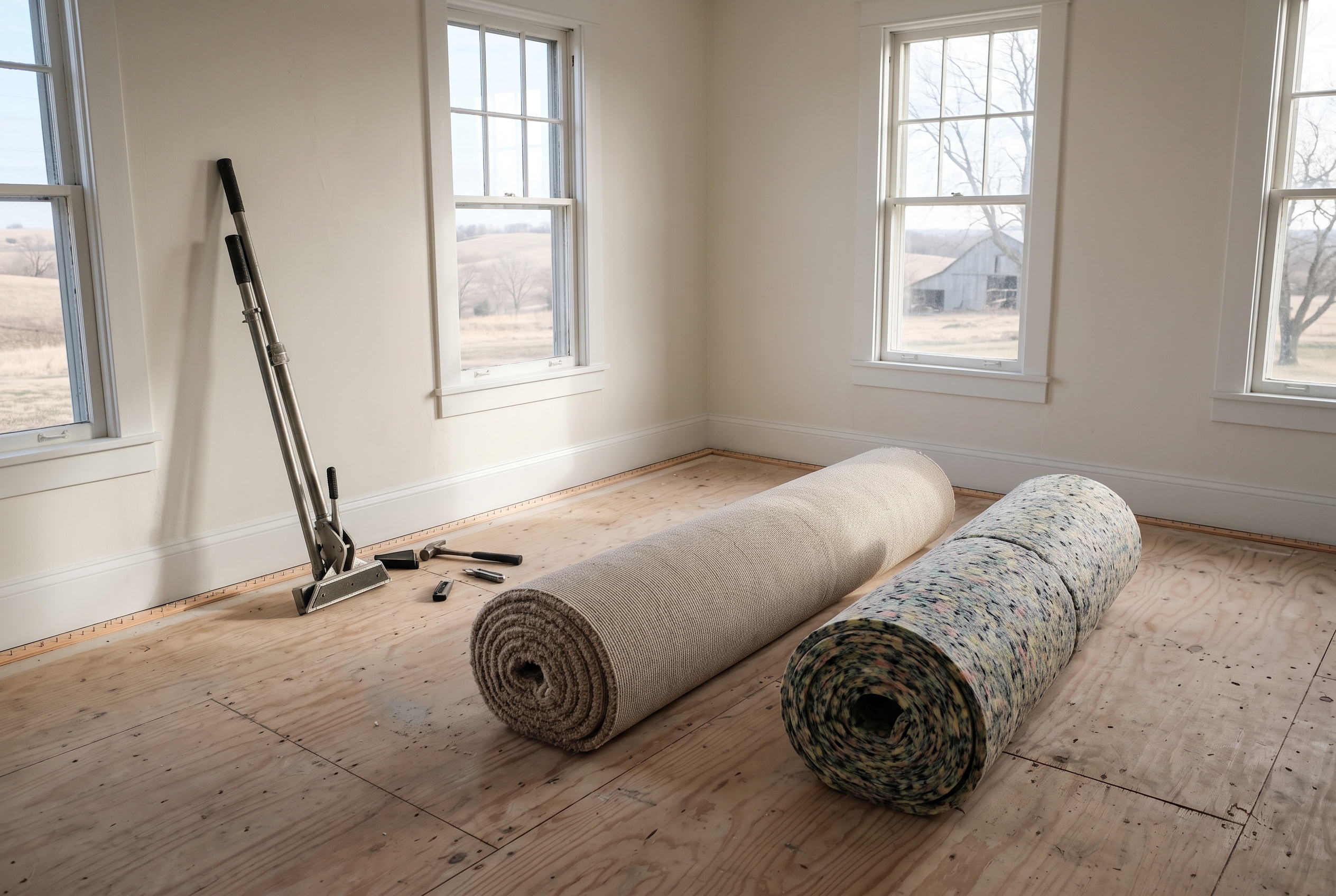
Preparing for carpet installation comes down to three jobs. Empty the rooms and finish the other work before the installers arrive, keep the house at normal temperature and humidity around the install, and check the work before the crew leaves. How much falls to you depends on what is coming out, how much furniture there is, whether there are stairs and how old the house is.
Two weeks before, finish any painting or wall repairs, agree on where the seams will fall, and settle who is moving the furniture and taking up the old floor.
The day before, empty the rooms down to the bare carpet, unplug and box the electronics, vacuum the old carpet, and make sure the heat or air conditioning is running.
On installation day, be there at the start to walk the rooms with the lead installer, keep pets and children away from the work, and expect a few loud, dusty hours per room.
Before the crew leaves, walk every room again and check seams, edges, doors and transitions while the installers are still there to fix anything.
In the first weeks, keep fresh air moving, vacuum often while the loose fibers work out, and call if ripples appear.
| When | What to do | Why it matters |
|---|---|---|
| Two weeks before | Paint, patch, settle seams and who moves what | Carpet goes in last |
| The week before | Empty closet floors; plan for pets and parking | Saves time on the day |
| The day before | Clear rooms, unplug electronics, vacuum, run the HVAC | Installers start on a clear floor |
| Installation day | Walk the job at the start; stay reachable | Decisions get made in minutes |
| Before the crew leaves | Check seams, edges, doors, transitions | Fixes are easiest now |
| First weeks | Ventilate, vacuum, watch for ripples | Settling is normal; ripples are not |
What to Do Before Carpet Installation
Start about two weeks before carpet installation, because the things that slow the day down are all decided ahead of time: unfinished work in the room, a seam plan nobody agreed on, and furniture with nowhere to go. This order works in most homes.
- Finish painting, wall repairs, trim and any other work in the rooms getting carpet.
- Go over the seam plan, the pattern direction and every doorway where carpet will meet another floor.
- Settle what the installation includes: who moves the furniture, who takes up and hauls away the old carpet and pad, and whether stairs and closets are part of the job.
- Empty the closet floors in every room getting carpet, and clear out anything stored under the beds.
- Plan for pets, children and anyone working from home on the day, because the work is loud.
- Clear a path from the driveway to each room, and a dry, flat spot in the garage or on the drive where the carpet can be rolled out and cut.
- The day before, vacuum the old carpet thoroughly. It cuts down the dust that flies when it comes up.
- Keep the heat or air conditioning running at normal living temperatures from two days before until three days after.
The last item matters more than it looks. The Carpet and Rug Institute's installation standard asks for indoor temperatures between 65 and 95 F and humidity no higher than 65 percent. Those conditions should hold for 48 hours before installation, during it and for 72 hours after, and carpeted rooms should never drop under 50 F.
Here, that means a January install happens with the furnace on and a July install with the air conditioning running, which also pulls down the summer humidity. Winter is no reason to wait for new carpet. A closed-up spare room or a cabin that is not heated all winter is the one to warm up for a couple of days first.
Paint and Wall Repairs Come First
Finish painting, wallpaper, patching and trim work before the carpet goes in. Carpet should be the last trade in the room, because ladders, drop cloths, paint drips and tape are easier on a floor you are about to throw away than on new pile.
Paint the baseboards beforehand too, and plan a light touch-up afterward, since the installers work right up against them. If new wall colors are part of the plan, choose them with a carpet sample in hand. We mix Benjamin Moore paint in our studio, and the same team that helps you choose the carpet will pull paint colors against your sample. On a larger remodel, our job supervision and coordination service keeps the trades in the right order for you.
Settle the Seams, Pattern Direction and Transitions
Most carpet is made in 12-foot widths, with some in 15-foot widths, so any room wider than the roll has at least one seam. Decide where the seams go before the carpet is cut.
A good seam runs the length of the room, so foot traffic moves along it instead of across it. It stays away from a window that would light it from the side, from doorways and from the spots where people turn. Even a well-made seam is never invisible, so it belongs where it shows least.
A patterned carpet needs extra material so the pattern lines up across seams, which is why its order is larger than the room's square footage suggests. Ask how the pile will run, too: pieces that meet must have their pile running the same way, and ideally the pile lays toward the room's entrance.
Then look at every doorway where carpet will meet tile, vinyl or wood. Each one gets a transition strip that protects the carpet's edge, and the height difference between the two floors decides which strip it is.
Does the Room Need to Be Empty for Carpet Installation?
Yes. Every piece of furniture has to leave the room, along with everything on the floor, because the old carpet comes up wall to wall and the new carpet is stretched across the whole room at once. Closet floors need emptying too, and cords and wiring need to be up off the floor.
Take down anything breakable on the walls and shelves of the rooms being carpeted and the rooms beside them. Installers pull the carpet tight with a knee kicker and a power stretcher, and the thumps carry through the walls. Pin or tie floor-length draperies up off the floor so they do not get caught at the edges, and clear small rugs, plants and wastebaskets out of the path from the door.
Do Carpet Installers Move Furniture?
Some installations include moving the furniture and some do not, and when it is included it is often an added charge. Ask before the day what the installation covers, and ask the same about the old carpet: who takes it up, and whether it is hauled away.
Even when furniture moving is included, a few jobs nearly always stay with you. Empty the drawers, cabinets, bookshelves and closets. Pack china, glass and anything fragile. Disconnect and box the electronics and computers, and take down anything hung on the walls. Set aside an evening for it.
Beds, Electronics and the Heavy Things
Some furniture needs more than a strong back before carpet installation, and the heavy or delicate pieces are the ones to plan for in advance.
- Beds: strip them, and take apart the frame and headboard if they will not fit through the door in one piece.
- Televisions, computers and stereos: unplug them, label the cords with tape and box the small parts.
- Aquariums: drain and move them, or have them moved, well before the day.
- Waterbeds: drain them completely; they cannot be moved full.
- Pianos, gun safes and pool tables: book movers who handle them, since they need special equipment and a pool table has to be releveled afterward.
- China cabinets and bookcases: empty them first, or they are too heavy to move safely.
Taking Up the Old Carpet
Decide before the day who takes up the old carpet and pad and where it goes. If the installation includes removal, all you need to do is clear the room. If you are taking it up yourself to save money, do it the day before so the installers start on a clean subfloor.
To take up carpet yourself, pull it off the tack strip at a corner with pliers. Cut it into strips about three feet wide with a utility knife, and roll each strip with the back facing out. Pull up the pad, which is usually stapled down, then pull or hammer flat every staple left behind.
Leave the tack strip in place unless it is broken or loose; the installer will decide whether it can be reused. Its pins are sharp, so keep pets, children and bare feet out of the room until the new carpet is down. Vacuum the subfloor last. Old carpet and foam pad can sometimes be recycled, so ask about recycling options before it all goes to the landfill.
What You Might Find Under Old Carpet in an Older Home
In older farmhouses and ranch homes, the floor under the carpet is often a surprise, and each common surprise changes the job a little. Lift a corner of the old carpet in a closet a few weeks ahead and look.
Plenty of older homes hide oak or pine flooring under carpet laid decades ago. Whether it is worth keeping depends on its condition and whether you want wood in that room, and our hardwood flooring guide can help you think it through. Decide before carpet day, because once new carpet is stretched over the wood, that choice is made for years.
Old sheet vinyl or square floor tiles call for care. Some older vinyl flooring, resilient tile and the black adhesive under them contain asbestos, and you cannot tell by looking. The EPA's advice is to treat any material you are unsure of as if it does and leave it alone. Do not sand, scrape or chip it; cover it with the new floor if you can, which carpet does well. If it has to come out, that is work for a trained asbestos professional.
With the old carpet up, the subfloor is exposed for the first time in years, which makes it the moment to screw down boards that squeak. Ask for it before the new carpet goes down.
Pet stains in the plywood are another common find. They get cleaned and sealed with a stain-blocking primer so the odor does not come back up through the new carpet. Soft or rotted spots, usually near a bathroom or an outside door, have to be cut out and replaced before anything goes over them, and that can add time to the day.
Extra Steps for a Basement on Concrete
Carpet on a basement slab needs a dry slab and a room whose humidity is under control. Most stretched-in carpet over pad does not call for a formal moisture test, yet concrete always passes some vapor, so give the slab a look first.
Tape a square of clear plastic to the bare concrete overnight: beads of water or darker concrete under it mean the slab is too damp for now. Our guide to choosing carpet padding covers the other signs of water and the pad that suits a slab, and if the basement takes on water after storms, that gets fixed before any floor goes down.
The air in the room is the part people forget. A Kansas basement in July can sit well over the 65 percent humidity that carpet installation calls for, so run a dehumidifier for a few days before the install and keep it running afterward. On the day itself, the tack strip is fastened into the concrete, and the pad should be a dense foam that will not hold water.
What Happens on Installation Day
Installation day follows the same order in almost every house, and knowing it helps you plan when to be home and when to stay out of the way.
- The installers arrive and walk the rooms with you to confirm the seam plan, the doorways and anything that has changed.
- The carpet and pad come in, or are cut outside first if the room is large.
- The old carpet and pad come up, if removal is part of the job, and the subfloor is vacuumed.
- The subfloor is checked, squeaks are fastened and any damage is repaired.
- New tack strip goes around the edges of each room, set a small gap away from the wall and never across a doorway.
- The pad goes down, trimmed to the tack strip, with its seams taped.
- The carpet is rolled out, cut to the room and seamed where needed, with the seam edges sealed.
- The carpet is power-stretched tight onto the tack strip, then trimmed and tucked at the walls.
- Transition strips go in at the doorways, the doors are rehung, and the scraps and old material are cleaned up.
Plan to be there at the start, for the walk-through, and at the end for the final check. In between, stay reachable. Expect hammering, the thump of the stretcher and a vacuum running, plus dust while the old carpet comes up, so it is a good day for pets and small children to be somewhere else.
The pad that goes down is its own decision, made when you choose the carpet, and it should match the carpet's construction and stay within the carpet maker's requirements.
How Long Does Carpet Installation Take?
Carpet installation takes anywhere from a few hours to a couple of days, depending on the size of the job, the layout of the rooms and whether old flooring has to come out first. A single bedroom is often done in a morning, and most homes are finished in a day.
| Job | Typical time |
|---|---|
| One bedroom | A few hours |
| Two or three bedrooms and a hall | Most of a day |
| A whole main floor | A full day, sometimes two |
| A staircase | Adds a few hours |
| Old carpet removal | Adds time to every room |
Subfloor repairs, patterned carpet that has to be matched at the seams, rooms full of angles and closets, and heavy furniture all stretch the day. Stairs take longer than their size suggests, because each step is fitted and fastened by hand.
Carpet on Stairs
Stairs are the slowest and most skilled part of a carpet job, and the look you choose for them, usually one of two common styles, is a design decision worth making early.
In a waterfall, the carpet drapes over each stair nose and falls straight down the riser. It is simpler and suits casual stairs and busy family homes. In the wrapped style, sometimes called cap-and-band or upholstered, the carpet is pulled tight around the nose and tucked under it so the shape of each step shows. It looks tailored and suits a formal entry or a staircase that is a feature of the room.
A stair runner, a strip of carpet down the middle with wood showing at each side, is a third choice for stairs with good treads. Whichever you choose, the pile runs down the stairs and the pad wraps over each nose.
The Final Walk-Through Before the Crew Leaves
Walk every room with the lead installer before the crew packs up, because anything that needs fixing is easiest to fix while they are still there. Check these, room by room:
- Seams: tight, flat and without gaps, and where you agreed they would be. They will not be invisible, but they should not jump out from the doorway.
- Edges at the walls: tucked neatly, with no frayed yarn or backing showing.
- Transitions: firm underfoot, with no loose edges where carpet meets another floor.
- Stretch: no ripples, bubbles or soft spots as you walk across the room.
- Doors: every door swings without dragging on the new carpet.
- Vents and registers: cut out cleanly, with the covers back on.
- Closets and corners: carpeted and finished like the rest of the room.
- Leftover pieces: keep any reasonable scraps for future repairs.
- Paperwork: keep your receipt, the carpet's labels and warranty information, and a small cutting of the carpet together, and register the warranty if the maker offers it.
If anything about the carpet itself looked wrong before it went down, such as the wrong color or a flaw in the face, the time to stop is before it is installed. A visible defect that was installed anyway may not be covered for replacement.
Your First Weeks With New Carpet
You can walk on stretched-in carpet as soon as the installers finish, and move the furniture back the same day. Glue-down carpet is the exception: keep traffic off it for a day or two while the adhesive cures, and do not wet-clean it for a month.
When the furniture goes back, lift it or move it on furniture sliders, and set heavy pieces on furniture cups to spread their weight. A few things in the first weeks are normal:
- Loose fibers in the vacuum. Cut pile sheds for a while; vacuum often and it tapers off over the first few months.
- A single tuft sticking up. Clip it level with scissors; never pull it.
- Light and dark patches in plush carpet. That is the pile lying in different directions and catching the light, a trait of plush carpet and not a defect.
- A feel that differs from the sample. New carpet has been rolled tight for shipping and takes about a month to relax.
Ripples or wrinkles are another matter. Carpet that ripples needs a re-stretch with a power stretcher, which means moving the furniture back out, so call about it as soon as you see it.
Can You Sleep in the Room After Carpet Installation?
Yes, you can sleep in the room the same night. Open a window or run the fan on your heating and cooling system to keep fresh air moving, and the new carpet smell fades quickly.
Clearing the New Carpet Smell
Fresh air clears the new carpet smell, usually in less than three days. Open windows and doors when the weather allows, use exhaust fans, and run the fan on your heating and cooling system during the installation and for about 72 hours afterward.
If indoor air quality matters to you, look for carpet certified under Green Label Plus, the carpet industry's program for low-emission carpet, pad and adhesive. The carpet we sell from Shaw Floors carries it.
Common Carpet Installation Mistakes
Most carpet problems that get blamed on the carpet start on installation day. These are the installation mistakes a careful crew avoids, with the sign of each and its fix.
Skipping the power stretcher is the most common. A knee kicker alone cannot pull carpet tight enough, so carpet laid that way ripples within months. The industry's installation standard makes the power stretcher mandatory, and the fix for ripples is a proper re-stretch.
Seams in the wrong place come next: across a hallway, facing a bright window, or where traffic turns. Those seams show and wear faster. A seam that has pulled apart or frayed can be re-seamed, but its position is fixed once the carpet is cut, which is why the seam plan comes first.
Pile that runs two directions at a seam makes the two sides look like different colors in some light. Matching the pile direction of every piece prevents it; after installation, the only fix is replacing one side.
A pad that is too thick or too soft for the carpet lets it stretch out and wear early, and it can affect the carpet's warranty. Seam edges that were never sealed fray and unravel.
Carpet stapled to the tack strip, or tack strip run across a doorway, leaves lumps and edges that catch toes. Subfloor repairs that were skipped leave squeaks under brand-new carpet. And carpet laid over a damp basement slab or an old layer of carpet starts with trouble built in.
If you see one of these after installation, call about it promptly. Workmanship problems are easier to fix in the first weeks than after a season of wear.
What Can Add to the Cost of Installation
The cost of carpet installation starts with the square yards of carpet and pad, and a handful of things add to it. Knowing them helps you compare quotes on the same terms.
- Taking up and hauling away the old carpet and pad, or old tile or vinyl.
- Moving furniture, especially heavy or specialty pieces.
- Stairs, which are priced by the step or the staircase because they are slow handwork.
- Subfloor repairs: squeaks, stains, damaged or rotted sections.
- Transition strips at doorways.
- Patterned carpet, which needs extra material to match at the seams.
- Trimming doors that drag on the new carpet.
Whoever installs your carpet should be able to answer a few questions plainly. How long have they been doing it, and are they insured? What does their workmanship warranty cover? What is in the written quote, line by line, and what are the payment terms?
When your plan is set, we give you a price quote for the project, and financing through our lending partners can spread the cost out.
Carpet Installation With Us
At Draperie Decor Interiors in Sabetha, we sell and install carpet, and residential installation is one of our flooring services, along with design consultation and job supervision and coordination for larger projects. You can browse the styles in our carpet catalog, from Shaw Floors, Anderson Tuftex and Philadelphia Commercial, or let our shop-at-home service bring samples to your front door.
Because we are a design studio as well as a flooring store, the carpet decision rarely happens on its own. We help you settle the carpet, the paint and the window treatments together, and we work with homeowners across northeast Kansas and southeast Nebraska, from Sabetha to Hiawatha, Seneca, Marysville and Falls City.
Carpet Installation Questions
Do Carpet Installers Take the Doors Off?
Usually, yes, for doors that swing over the carpeted floor. They come off so the carpet can be laid under them and go back on at the end. New carpet and pad can sit higher than the old floor, so a door that drags afterward may need its bottom trimmed.
Do the Baseboards Have to Come Off?
No. Carpet is installed up to the baseboards and tucked at the wall, so the baseboards stay put. Quarter-round trim left from a previous hard floor is often removed for carpet.
Should You Vacuum Before the Installers Come?
Yes. Vacuuming the old carpet the day before cuts down the dust when it is pulled up, and the subfloor gets vacuumed again once it is exposed.
Can New Carpet Go Over Old Carpet?
No. New carpet goes over a clean subfloor and new pad. Laid over old carpet, it ends up soft, uneven and hard to stretch, and the industry's installation standard advises against it.
If you are getting ready for new carpet, or still deciding which carpet to get ready for, we would be glad to talk through the rooms, the timing and the details with you. You can request a consultation to get started.


