

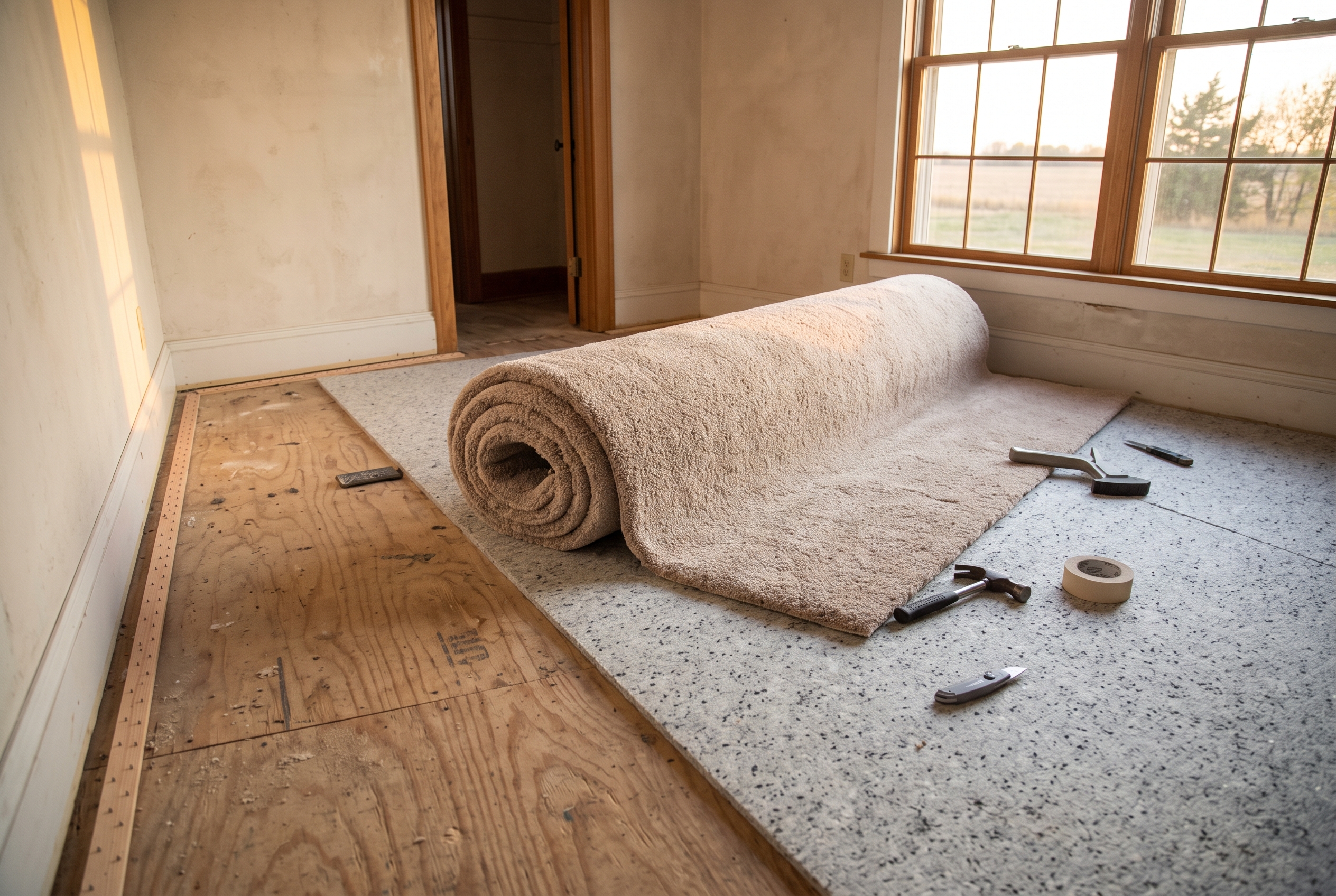
The right carpet padding is the one that matches the carpet you picked and the room it is going in. Density matters more than thickness, and thickness has a ceiling: no more than 7/16 inch under most carpet in a home, and thinner and firmer than that under loop and Berber styles.
Cut pile carpet (plush, Saxony, textured and frieze) wants a resilient pad no thicker than 7/16 inch, usually bonded or prime foam at 6 to 8 pounds of density. Go to 8 pounds in family rooms and anywhere the kids run laps.
Loop and Berber carpet needs a thin, firm pad, 3/8 inch or less, in dense foam, fiber or flat rubber. A soft pad lets the loops flex until they loosen.
Stairs and hallways take the firmest, densest pad the carpet allows, and thinner is better than thicker on every tread.
Basements on concrete call for a dense urethane foam pad laid over a slab that shows no sign of water coming up through it. The slab, not the pad, is what decides whether a basement can be carpeted.
Homes with pets do best with a pad that carries a spill film, so an accident stays in the carpet where you can clean it.
Bedrooms where comfort comes first can take memory foam or a dense prime foam at the full 7/16 inch. The extra softness comes from the foam itself.
Carpet you already own that ripples, crunches or stays flat usually has a pad problem, and the fix is often new pad under the same carpet.
| Your carpet or room | Pad to ask for | Thickness | Density |
|---|---|---|---|
| Cut pile in living areas | Bonded or prime foam | 7/16 in. or less | 6 to 8 lb |
| Loop or Berber | Dense foam, fiber or flat rubber | 3/8 in. or less | 8 lb or more |
| Stairs and hallways | Firm foam or frothed foam | 3/8 to 7/16 in. | 8 lb or more |
| Basement slab (dry) | Dense urethane foam | 3/8 to 7/16 in. | 8 lb or more |
| Pets in the house | Same pad, with a spill film | Per carpet type | 8 lb |
| Comfort-first bedroom | Memory foam or prime foam | 7/16 in. or less | Per carpet spec |
What Carpet Padding Does
Carpet padding, which the trade calls cushion, is the layer between your carpet and the subfloor that takes the force out of every step. Without it, each footfall crushes the yarn against a hard floor and bends the backing that holds the yarn in place.
That backing is the part you never see. Carpet is yarn tufted through a backing, and when the backing flexes too much, or not at all, the yarn loosens and the surface starts to look tired. A good pad lets the carpet give a little and spring back, so the pad decides how long a carpet looks new almost as much as the carpet does.
Carpet seldom wears through; it gets ugly first, crushed flat in the lanes where everyone walks. A dense pad is what slows that down. It also makes a room quieter and warmer underfoot, and it makes vacuuming more thorough, because the carpet can lift slightly as the vacuum passes.
The pad is written into most carpet warranties as well. Carpet makers, Shaw Floors among them, set minimum requirements for the pad under their carpet, and a pad that falls short can leave the carpet without warranty coverage.
Around the edge of the room sits the tack strip: thin wood strips with angled pins that grip the carpet once it is stretched. The pad is trimmed to the inside edge of the strip, so it never covers the pins.
Types of Carpet Padding
Carpet padding comes in six main types, and for most homes a dense bonded foam or a prime foam pad is the right answer. The others earn their place in particular rooms: memory foam where comfort leads, frothed foam and rubber where traffic is heavy, fiber under loop carpet, and a spill film wherever pets and children are.
| Type | How it feels | Best under | Watch for |
|---|---|---|---|
| Bonded foam (rebond) | Springy, medium firm | Most carpet, most rooms | Low-density versions flatten early |
| Prime and memory foam | Soft and even | Bedrooms and quiet rooms | Still capped at 7/16 in. |
| Frothed foam | Firm and dense | Halls, stairs, busy rooms | Costs more |
| Flat or waffle rubber | Firm (flat), bouncier (waffle) | Heavy use, loop carpet | Heavy; waffle is less stable |
| Fiber or felt | Very firm and thin | Berber and loop | Little give underfoot |
| Pad with a spill film | Same as the foam beneath | Pets, kids, dining rooms | Does not stop slab moisture |
Rebond (Bonded Urethane Foam)
Rebond, or bonded urethane foam, is the multicolored pad you have probably seen: chips of scrap foam ground up and bonded back together with heat and adhesive into a sheet. It is the most common carpet pad sold, and it is mostly recycled foam, much of it trimmed from furniture and mattress making.
Rebond is a sound choice for most carpet in most rooms when its density is right. The confetti look tells you nothing about quality; the density printed on the roll does, and a 6-pound rebond and an 8-pound rebond feel very different a few years in. Press a sample with your thumb. A dense pad pushes back quickly and evenly, while a light one gives way and stays dented for a moment.
Prime Foam and Memory Foam
Prime foam and memory foam are the comfort picks among carpet pads. Prime foam is poured and sliced in one piece, the way furniture and mattress foam is made, so it feels uniform from edge to edge. Memory foam, the slow-recovery foam from mattresses, is now made as a premium, high-density carpet pad that soaks up the force of each step.
In a bedroom, a nursery or a family room where you sit on the floor, a memory foam pad gives the softest step a carpet can have. Two conditions keep that comfort from costing you: the pad has to stay at or under the 7/16-inch limit, and it has to meet the cushion requirement for the carpet you chose. A memory foam pad that meets both is a good buy; one that gets its softness from extra thickness is a poor one.
Frothed Foam
Frothed foam is a thin, very dense pad made on the same kind of machinery that puts backings on carpet: liquid foam is spread onto a fabric layer and cured. It is firm, holds its shape for years and costs more than rebond.
Frothed foam suits hallways, stairs and rooms with constant traffic, where support matters more than a soft first step. Some frothed pads are made at around 10 pounds of density, well over a typical rebond.
Flat and Waffle Rubber Pads
Rubber carpet pads come in two shapes, and the flat one is the better under most carpet. Flat rubber is a solid sheet, firmer and more stable. Waffle rubber is molded with ribs and hollows that make it feel bouncier underfoot, and that same give makes it the less stable of the two.
Flat rubber is dense, heavy and long-lasting, which suits loop carpet and busy rooms, and it costs more than foam. Rubber pads are graded by weight in ounces per square yard instead of pounds per cubic foot, so a rubber pad's number cannot be compared with a foam pad's.
Fiber and Felt Pads
Fiber and felt carpet pads are thin, dense mats of synthetic fiber, recycled textile fiber or natural fiber such as jute. They give carpet a firm, flat foundation with very little spring.
That firmness is what Berber and other loop carpets want. If you are after a plush, sink-in feel in a bedroom, choose foam instead. Like rubber, fiber pads are graded by weight per square yard.
Pads With a Moisture or Spill Film
A carpet pad with a spill film has a thin plastic layer bonded to its top face, so a spill or a pet accident stays up in the carpet instead of soaking into the foam. Some are rated to hold a spill out of the pad for about a day, which gives you time to blot and clean it.
The film faces up, toward the carpet. It cannot make the whole floor watertight, because liquid that runs to a wall or a pad seam can still reach the subfloor, so cleaning fast still matters. A spill film is also no vapor barrier for a basement slab. It keeps spills from going down, while a slab problem is moisture coming up from underneath.
Is Thicker Carpet Padding Better?
No. Past about 7/16 inch, a thicker pad stops adding comfort and starts costing the carpet its life. The Carpet and Rug Institute's residential installation standard caps carpet cushion at 7/16 inch and requires the pad to meet the carpet maker's recommendations, warning that skipping them can void the warranty.
A thick, soft pad lets the backing flex deeply with every step, and that flexing loosens the yarn and strains the seams. A pad that rides higher than the tack strip also makes the carpet harder to stretch tight, so it is more likely to ripple later. The result is carpet that wears out early, and a warranty that may not cover it.
Thinner is not automatically better either. Below about 1/4 inch, a pad gives the carpet too little to push against, and the yarn takes the beating the pad was meant to absorb. For most homes the useful range runs from 3/8 inch for loop carpet to 7/16 inch for cut pile.
Thickness is printed in fractions of an inch, sometimes with millimeters beside it: 3/8 inch is about 9.5 mm and 7/16 inch about 11 mm. If a 1/2-inch pad is offered as a luxury upgrade, ask whether your carpet's maker allows it. The one exception to the cap is the maker's own spec. When a carpet's paperwork calls for a particular pad, that pad is the right one, and some carpets come with a cushion already bonded to their back and are glued down with no separate pad at all.
If you want a softer bedroom, a dense memory foam or prime foam at 7/16 inch will feel softer than a light pad at 1/2 inch, and it will last. Choose the thickness the carpet allows, then buy as much density as your budget allows.
How Dense Should Carpet Padding Be?
For bonded foam carpet padding in a home, about 6 pounds per cubic foot is the usual minimum, and 8 pounds is the common step up for family rooms, hallways and stairs. Density is simply how much a cubic foot of the pad weighs, and it is the best single predictor of how long a foam pad keeps its spring.
An 8-pound pad packs a third more foam into the same space than a 6-pound pad, so it supports the carpet better and flattens more slowly. Where the carpet will see years of daily traffic, those two extra pounds are worth paying for. In a guest room that sees a few visitors a year, a good 6-pound pad does the job.
Density and thickness work as a pair. A thin, dense pad outlasts a thick, light one under the same carpet, because density is what keeps pushing back after thousands of steps. That is why a 3/8-inch, 8-pound pad is a better buy for a hallway than a 1/2-inch, 5-pound one, even though the thicker pad feels plusher on the first day.
Numbers only compare within one type of pad. Foam pads are rated in pounds per cubic foot, while rubber and fiber pads are rated by weight in ounces per square yard, so the figures on two different types are on different scales. Even within foam, a memory foam pad and a rebond pad can feel different at similar numbers, which is why the carpet maker's requirement is what settles it.
You may also hear of a federal housing minimum for carpet cushion that has been around for decades. The cushion industry itself recommends better than that minimum, and so do we.
Matching the Pad to Your Carpet
The carpet's construction decides the pad before the room does. The styles on our carpet information page fall into a few groups, and each group has its own pad rule.
Plush, Saxony and textured carpets are the cut-pile styles most bedrooms and living rooms carry; Saxony is the smooth, dense, velvety version. They take a resilient, firm pad at 7/16 inch or less, typically 6 to 8-pound bonded foam or a prime or memory foam. A plush carpet already feels soft, so what it needs from a pad is support that keeps the pile from crushing.
Frieze is a cut pile with tightly twisted, curly yarn that hides footprints. It takes the same rule, and a denser pad helps the twist hold up in the paths people walk.
Level loop and Berber carpets have uncut loops anchored in the backing, which makes them the carpets most sensitive to a soft pad. A fiber pad, flat rubber or foam of 8 pounds or more keeps them stable. Too much give lets the loops pull and loosen, and the damage shows as runs and fuzzy rows.
Cut-and-loop patterns, which mix cut and looped yarn to draw a pattern, take a resilient, firm pad at 7/16 inch or less. Firm support keeps the pattern's lines crisp.
Carpet tile gets no separate pad, since any cushion it has is built into its backing. Carpet made for commercial wear is often glued straight to the floor or laid over a thin, firm pad. It comes with its own installation spec, so follow that spec even when the carpet goes into a home office or a basement.
Fiber matters too, because a resilient fiber holds up better over any pad. Our guide to carpet fibers like nylon and polyester covers that side of the choice.
The Right Pad Room by Room
Within each carpet's limits, the room decides how dense and how thin the pad should be: the more feet a room sees, the denser and thinner its pad. That one rule sorts the house.
Bedrooms and guest rooms see the least traffic, so they are where a memory foam or dense prime foam at 7/16 inch makes the most sense. You walk in barefoot and feel the difference.
Living and family rooms take daily traffic, furniture moving in and out and children playing on the floor, so they want 8-pound bonded foam or frothed foam. Playrooms and kids' rooms belong in the same group even when they are upstairs, because they get the hardest use in the house.
Hallways funnel every trip through the house into one narrow lane, so they get a thin, dense pad, and a soft pad shows its age there first. In upstairs rooms over living space, a good dense pad also soaks up footstep noise that would otherwise carry into the room underneath.
Carpet Padding for Stairs
On stairs, every step loads the front edge of the tread, the stair nose, so the pad there has to be firm. A soft pad lets the carpet fold sharply over that edge again and again; the nose wears first, and the stairs feel less solid underfoot. Use the densest pad the carpet maker allows, at the thin end of its range.
The pad wraps over each nose so the carpet never sits on a bare edge, and the nose itself should be rounded so it cannot cut the carpet or the pad. The pile is laid running down the stairs so it wears evenly. Whether the carpet drapes over each nose in a waterfall or wraps tight under it, the pad underneath follows the same rule. If your stairs already have carpet worn bald on the noses, a firmer pad is part of the fix when they are redone.
Carpet Padding for a Basement Concrete Floor
Carpet can go on a basement slab once you know the slab stays dry, and then a dense urethane foam pad at about 8 pounds is the sensible choice. Urethane foam itself does not feed mold or bacteria, and its density keeps it from flattening on hard concrete.
Most stretched-in carpet over pad needs no formal moisture test, but any concrete, even dry concrete, lets some moisture vapor through, so the slab still gets a look first. Basements are common here, and plenty of them double as storm shelters. Before carpet goes down, look for the signs of water on the concrete and walls:
- white, powdery deposits on the concrete
- dark, damp patches
- rust on nail heads near the floor
- a musty smell
- a tide line on the walls from past water
A simple check is to tape a square of clear plastic flat to the bare slab on all four edges and look under it the next day. Droplets on the plastic, or concrete that has turned darker under it, mean moisture is coming up and the slab is too damp. A dry result is encouraging, but it only tells you the slab might be dry enough.
If the basement takes on water after rain, fix that before any floor goes down. Gutters, downspouts, grading and a working sump pump solve more basement carpet problems than any pad can. A spill film on the pad will not help here, since it faces up and the water comes from below.
Carpet Pad Over Radiant Floor Heat
Over radiant floor heat, choose a thin, dense pad so the warmth reaches the room instead of being held in the floor. Thick, soft pads insulate, which is the opposite of what a heated floor needs.
The floor's surface should not run hotter than 85 F under carpet. Check the heating system's paperwork for the floor coverings it was designed to work under, and keep the carpet and pad within that.
Pad Choices for Pets, Allergies and Older Adults
Who lives in the house can change the pad as much as the carpet does. Pets call for a spill film, allergies for a low-emission certification, and anyone using a cane, walker or wheelchair for a firm, thin pad.
With pets, a spill film keeps accidents in the carpet, where a cleaner and an extractor can reach them, but you still want to clean them right away. Urine that gets past the film at a seam or a wall soaks into the foam. Once it is in the pad, the smell keeps coming back no matter how often you clean the surface, and that section of pad has to be replaced.
For allergies and indoor air, look for a pad certified under Green Label Plus, the industry program that tests carpet, cushion and adhesive in an independent lab for low chemical emissions. The carpet itself matters as much, and our post on allergy-friendly carpet choices covers the styles that are easiest to keep clean.
For older adults and anyone using a walker or wheelchair, choose a firm, thin pad and a low, level carpet. The federal accessibility standard calls for a firm cushion, or none, under carpet in public buildings, and notes that soft padding makes a wheelchair harder to push. The same holds at home, where firm footing is steadier for a cane or walker.
What Carpet Padding Costs
Carpet padding is priced by the square yard, like carpet, and its price follows the same specs that decide its quality: the type, the density and any film. These move the cost most:
- Type: rebond costs least; prime, memory, frothed foam and rubber cost more.
- Density: an 8-pound pad costs more than a 6-pound pad of the same type.
- Spill films and other treatments add to the price.
- The size of the job: pad is ordered for every square foot the carpet covers, stairs included.
A better pad usually costs far less than the step up to a better carpet, and it can do more for how long the carpet looks new. Pairing a good carpet with a low-density pad is the one place in a carpet project where saving money now costs you later.
The exception is a room you plan to redo soon, such as a rental or a basement you will finish properly in a few years. A 6-pound rebond is a sensible choice there.
When your plan is set, we give you a price quote for the project. If you would like to spread out the cost, our financing through lending partners lets you check your options without affecting your credit score.
Signs Your Carpet Pad Has Failed
If carpet you already own has started to ripple, crunch or flatten, a failing carpet pad is often the reason. These are the likeliest causes, in the order they usually show up:
- Ripples and wrinkles mean the carpet has loosened from its stretch, often because the pad was too thick or too soft to hold it, or because it was never power-stretched. The fix is a re-stretch with a power stretcher, which means moving the furniture out. If the pad is the cause, it has to be replaced or the ripples come back.
- A crunching or crackling sound comes from pad that has dried out and broken down. The fix is new pad.
- Flat lanes and footprints that do not recover mean a low-density pad has bottomed out and no longer pushes back. Compare a worn lane with a spot that sits under a sofa. If the protected carpet still looks new, a new pad may restore some of the feel, but crushed pile on top will stay crushed.
- A musty smell in a basement means the pad has gotten wet from the slab, a leak or a flood. Wet pad comes out, the slab dries and the water source gets fixed before anything goes back down.
- Pet odor that keeps returning means urine has soaked into the pad. The affected section of pad comes out, the subfloor under it is cleaned and sealed, and new pad goes in.
- Lumps or ridges you can feel come from pad pieces that overlap or were never taped. Properly laid pad is taped at every seam, with its seams kept away from the carpet's seams, so lifting the carpet and re-laying the pad cures it.
Re-stretching and pad replacement both take an installer with a power stretcher. They are not weekend jobs, because carpet pulled tight by hand ripples again.
Can You Replace Carpet Padding Without Replacing the Carpet?
Yes, when the carpet itself is still in good shape. The carpet is unhooked from the tack strip and folded back, the old pad is pulled up and the floor cleaned, new pad goes down, and the carpet is power-stretched back onto the strip.
It is not worth doing when the carpet's own pile is matted and worn, or when the backing is soaked through, as it often is after a pet problem or a flood. In those cases the pad and the carpet go together.
Can You Reuse the Old Pad Under New Carpet?
No. A used pad has already lost much of its spring, it carries every old spill, and it may not meet the cushion requirement of the new carpet, which puts the new carpet's warranty at risk. New carpet goes over new pad, and never over old carpet either.
What to Ask Before You Buy the Pad
Before you buy a carpet pad, ask about its specs, because the brand on a pad matters less than what it is made of and how dense it is. Whoever sells you the carpet should be able to answer these quickly:
- What type of pad is it: bonded, prime, memory, frothed, rubber or fiber?
- How thick is it, and is that within the limit for this carpet?
- What is its density, in pounds per cubic foot (or, for rubber and fiber, ounces per square yard)?
- Does it meet this carpet's cushion requirement, so the warranty stays in force?
- Does it have a spill film?
- Is it certified for low emissions under Green Label Plus?
- How is it priced, and is it shown in the quote?
Some carpet makers also sell their own pads and lengthen the carpet's warranty when the two are paired, so ask whether the carpet you are considering has a matching pad of its own.
Choosing Carpet and Pad With Us
At Draperie Decor Interiors in Sabetha, we sell and install carpet from Shaw Floors, Anderson Tuftex and Philadelphia Commercial, and you can browse the styles in our carpet catalog before you visit. We are a design studio first, so choosing carpet with us is a one-on-one conversation about the room, the people who use it and how you want it to feel.
If getting to our showroom is hard, our shop-at-home service brings samples right to your front door, so you can see them in your own light. Professional installation is one of our flooring services, and we work with homeowners across northeast Kansas and southeast Nebraska, from Sabetha to Hiawatha, Seneca, Marysville and Falls City.
Carpet Padding Questions
Which Side of a Carpet Pad Goes Up?
The side the maker marks to face the carpet goes up. On a pad with a spill film, that is the film side, so spills stay on top of the pad.
How Long Does Carpet Padding Last?
A pad of the right density lasts as long as the carpet over it, which is why some makers warrant their pads for the life of the carpet. When the carpet is replaced, the pad is replaced with it.
Can You Use Carpet Pad Under Vinyl Plank or Laminate?
No. Carpet pad is far too soft for a floating floor, and the planks would flex at the joints until they gapped or broke. Vinyl plank and laminate go over the thin, dense underlayment their maker approves, or over the pad already attached to the planks.
Do You Need Carpet Pad Under an Area Rug?
No. An area rug takes a rug pad, which is a different product: a thin felt or felt-and-rubber mat cut slightly smaller than the rug. Carpet pad is made to sit under stretched carpet and does not grip or wear well loose on a floor.
What Happens to the Old Pad?
Old foam pad can be recycled, and most new bonded pad is made from recycled foam, including pad pulled up from homes. Ask about recycling when you plan the removal of the old carpet and pad.
If you have a carpet in mind, or a room that needs one, tell us about the room and how you live in it, and we will help you find the carpet that suits both. You can request a consultation with our design team to get started.


